Water Damage Restoration in Ferndale, MI
The first 24 hours after a water loss set the ceiling on what your restoration will cost. Standing water removed, air movers placed, dehumidifiers running, and moisture readings documented — that is what separates a $3,000 dry-out from a $30,000 rebuild.
Family-Owned · Insured & Licensed · 24/7 Emergency Dispatch
6.6 miles from Ferndale · on site in 25 minutes
A local water damage restoration crew near Ferndale
A local crew covers Ferndale from our Birmingham Headquarters, 801 S Adams Rd, Birmingham, MI 48009: 6.6 miles from the center of Ferndale. A crew is on site in 25 minutes, 24/7. If that crew is on another job, the next crew comes from our Troy Office, 7.2 miles away.
In 48220, the jobs we see most are historic plumbing and basement seepage. One person answers your calls from day one to the last repair, and the itemized estimate, moisture log and photos go straight to your adjuster. Homeowners rate us 5.0 on Google from 159 reviews. Call (586) 277-1069.
What Ferndale Homeowners Need to Know
Ferndale’s historic housing stock averages close to 100 years old — drain line ages, pipe materials, and basement waterproofing systems all need to be assessed individually per home.
Housing here is predominantly 1920s–1940s city homes with brick, stucco, and stone facades. The most common restoration-related issues in Ferndale are historic plumbing, basement seepage, combined sewer backup. Our crews treat each property as its own project — scope, drying time, and rebuild needs are written based on what we measure on site, not a generic playbook.
Ferndale's historic housing stock averages close to 100 years old, and restoration here requires individual assessment of drain line ages, pipe materials, and basement waterproofing systems on every project. There is no standard Ferndale home. Scope writing on each project takes longer than in newer subdivisions because the building conditions drive the restoration approach more than any single playbook ever could.
For water damage work specifically in Ferndale, the dominant driver we see on local jobs is historic plumbing — which affects how fast water spreads, where it hides, and how long drying realistically takes.
Seasonal pattern — Ferndale
Year-round historic plumbing work; summer storm events drive the concentrated sewer backup and basement flooding annual spikes.
Local conditions in Ferndale
Soil & Water Table
Ferndale's 1920s-1940s housing stock averages close to 100 years old, and drain line ages, pipe materials, and basement waterproofing vary enormously home to home. There is no single 'Ferndale profile' — every project starts with individual home assessment because no assumption carries across the city.
Building Stock
Ferndale's 1920s-1940s city homes feature brick, stucco, and stone facades with lath-and-plaster interiors, original hardwood, and aging plumbing. Every home is effectively its own assessment because material and infrastructure ages vary enormously within the same neighborhood.
Dispatch & Access
Historic city lots have constrained access in most neighborhoods. A crew is on site in 25 minutes from the nearest Prime office.
Ferndale Neighborhoods and Districts We Cover
Ferndale spans roughly 3.9 square miles immediately north of 8 Mile Road, sharing its southern boundary with the City of Detroit. The Downtown 9 Mile district between Woodward and Livernois holds the densest commercial fabric, with two-story brick mixed-use buildings dating largely to the 1920s. The Woodward Avenue corridor bisects the city north-south and separates East Ferndale (between Woodward and Hilton/Pinecrest) from West Ferndale (between Woodward and Livernois). The west-side neighborhoods near the Detroit border, including the area around Wanda, Saratoga, and Pearson, contain some of the oldest housing in the city: 1910s-1920s wood-frame bungalows, four-squares, and small two-story homes. The MLK/Livernois corridor anchors the far west side. East Ferndale neighborhoods like the area around Oakridge, Burdette, and Garden Lane skew slightly newer (late 1920s-1940s) but retain the same bungalow-and-basement typology that drives most restoration work.
Recent Storm History — Ferndale, MI
Ferndale's storm and loss history centers on the August 11, 2014 Metro Detroit flood, which devastated west-side and south-Ferndale basements: the combined-sewer system serving the blocks south of 9 Mile backed up across the neighborhood and produced category-3 sewage losses in hundreds of homes. The June 25-26, 2021 flood was a near-repeat event, with many of the same homes taking on a second round of sewage water. The December 21-22, 2013 Michigan ice storm caused heavy limb damage across the city's older tree canopy and produced widespread roof and gutter losses. The April 15, 2026 windstorm added a recent layer of wind and tree-impact claims. Restoration in Ferndale's pre-1940 housing stock is technically demanding: lath-and-plaster walls require full demolition under industry-standard category-3 protocols, original wood subfloors saturated with sewage are typically non-salvageable, and asbestos-containing pipe wrap and floor tile are common findings during demolition.
Working With Your Insurance Carrier in Ferndale
Ferndale carrier representation skews toward State Farm, Allstate, AAA, Auto-Owners, Citizens, Liberty Mutual, and Progressive on the personal-lines side, with Frankenmuth and Hastings Mutual showing on independent-agent placements. The pre-1940 housing concentration on the west side creates frequent Coverage A inadequacy on policies written without extended replacement cost or inflation-guard endorsements; rebuild costs for original wood-frame bungalows with plaster, original windows, and knob-and-tube remediation routinely exceed scheduled limits. Xactimate is the standard estimating platform. Sewer backup riders are heavily relevant: the west-side blocks south of 9 Mile sit on combined-sewer infrastructure that has produced repeated category-3 losses, and policies without backup coverage leave homeowners exposed to full out-of-pocket exposure on sewage events.
Prime Restoration is a licensed Michigan restoration contractor. We document project scope with detailed, itemized paperwork so homeowners have clear line-item records to submit to their carrier.
Permits & Code Compliance — Ferndale
Rebuild work in Ferndale is permitted through the Ferndale Building Department under the 2015 Michigan Residential Code for houses, the 2021 Michigan Building Code for commercial buildings, and the adopted electrical, mechanical, and plumbing codes. Building, electrical, mechanical, and plumbing permits are issued separately. The city's high concentration of pre-1940 housing on the west side means lead-paint considerations under federal RRP and HUD lead-safe practices govern nearly all rebuild scopes, and asbestos surveys under EGLE Part 115 and Michigan Michigan safety rules are standard before demolition on pre-1980 homes. Plaster, original windows, transite ducting, vermiculite insulation, and 9x9 floor tile are common ACM findings. Inspections follow the standard rough/insulation/final sequence. Sewer-lateral and water-service work require DPW coordination.
Sources: Michigan LARA: current code books · LARA: 2021 residential code injunction notice
Water Damage Restoration — Ferndale, MI
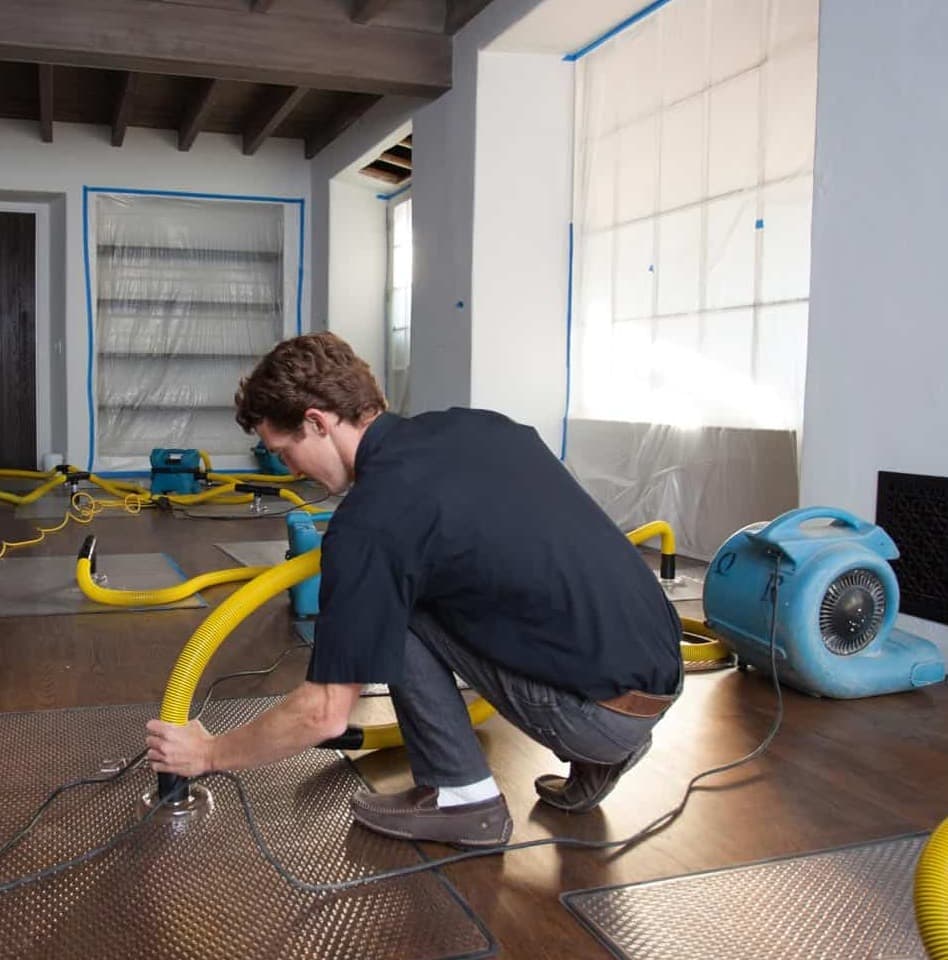
Prime Restoration provides 24/7 emergency water damage restoration built around the industry-standard mitigation protocol. Our crews extract standing water, set up containment, install industrial air movers and LGR dehumidifiers, and monitor moisture levels daily until the structure reaches documented dry standard. Every project is photographed and written up in Xactimate so homeowners have detailed line-item scope to submit to their insurance carrier.
Common causes we see in Ferndale
- •Supply line failure (washer hose, toilet, dishwasher)
- •Burst or frozen pipe
- •Water heater rupture
- •Sump pump failure during heavy rain
- •Roof leak from ice dam or storm
- •Sewer line backup
Signs to watch for
- •Visible standing water or saturated carpet
- •Musty or damp smell
- •Swollen baseboards, warped hardwood, or bubbling paint
- •Water stains on ceilings or walls
- •Sudden spike in humidity
Our Water Damage Process in Ferndale
The same documented process on every project.
1. Emergency Response & Inspection
A trained technician arrives, photographs the scene, identifies the water source, and maps affected materials with moisture meters and thermal imaging following industry-standard mitigation protocol.
2. Water Classification & Containment
Water is classified Category 1 (clean), 2 (gray), or 3 (black) and Class 1–4 by evaporation load. Non-affected areas are contained with 6-mil poly to prevent cross-contamination.
3. Water Extraction
Truck-mounted extractors and submersible pumps remove standing water. Saturated carpet pad is removed and disposed of. Drilling weep holes into wall cavities lets trapped water drain.
4. Structural Drying
Air movers, LGR dehumidifiers, and directed heat are set based on a written drying plan. Daily moisture readings are logged until materials reach dry standard.
5. Cleaning & Sanitization
Affected materials are cleaned with professional-grade antimicrobial. Contents are cleaned, dried, and inventoried for pack-out when needed.
6. Reconstruction & Xactimate Documentation
Drywall, flooring, trim, and paint are rebuilt to complete the project. Every line item is documented in Xactimate so you have detailed paperwork for your insurance carrier.
Equipment we bring to Ferndale
Reviews
What Ferndale Area Homeowners Say
5.0 Stars · 159 Verified Google Reviews
“Had a really good experience with Prime Restoration for mold remediation. They were professional, clear about the process, and actually made me feel confident about the process. Not pushy. I'd definitely recommend them around Bloomfield Hills”
Christian H.
Bloomfield Hills, MI
“Prime Restoration is a solid company in Michigan for basement floods and water damage. They're professional, knowledgeable and the kind of team you'd want handling a stressful situation.”
Nathan M.
Verified Google Review
“Prime Restoration in Bloomfield has an outstanding team for water damage restoration. Their crew is phenomenal. great people with top notch character who clearly know their stuff. Highly recommend for anyone facing water damage in Bloomfield.”
Ahmed W.
Bloomfield, MI
“Best in the game did my basement because it flooded and they left no messes clean and efficient”
Adam J.
Verified Google Review
“The Prime Restoration team was absolutely fantastic! Very professional and communicative. Completed the job in a timely manner. I would highly recommend!”
Jerome K.
Verified Google Review
“I called five different companies for restoration work, and Prime Restoration was hands down the fastest and most fair on price. They got me a quote the same day, while others were still "getting back to me." Their team works fast.”
Sean B.
Verified Google Review
Water Damage Questions — Ferndale, MI
Common questions from Ferndale homeowners before they call.
Why does every Ferndale restoration project start from scratch?
Ferndale's housing stock averages close to 100 years old, and individual homes vary enormously in drain line age, pipe materials, basement waterproofing, and structural condition. There's no standard 'Ferndale home' — a block can contain homes with original 1920s plumbing next to homes that have been fully updated in the 2010s. Every restoration project here starts with individual assessment rather than assumptions from similar-looking homes nearby.
How fast can a crew reach my home after water damage?
Our dispatcher assigns a trained restoration crew as soon as you call. Most residential losses are reached within about 25 minutes across our core service area, though severe weather or freeway closures can extend response time.
Do you work with my insurance company?
Prime Restoration is a licensed restoration contractor. We document the full project scope in Xactimate — the same software adjusters use — so you have clear paperwork to submit to your carrier.
How long does structural drying take?
A typical Class 2 water loss reaches dry standard in 3–5 days. Class 3 losses with saturated walls, carpet pad, and subfloor usually run 5–7 days. We log moisture readings daily so drying time is based on measurements, not guesswork.
Can I stay in the house during drying?
For Category 1 (clean water) losses, most homeowners stay in place. Industrial air movers are loud (roughly 65–75 dB) and the affected area should stay contained. Category 2 and 3 losses often require temporary relocation until sanitization is complete.
Prime Restoration is a licensed restoration contractor. We document the full project scope with detailed, itemized paperwork so you have clear line-item records to submit to your carrier.
Related Services in Ferndale
Water Damage
Basement Flooding Cleanup in Ferndale
Basement water extraction, contents pack-out, structural drying, and sanitization.
Water Damage
Burst Pipe Water Damage in Ferndale
Emergency response to burst, frozen, or ruptured pipes — water extraction, wall cavity drying, and rebuild.
Water Damage
Ceiling Water Damage Repair in Ferndale
Ceiling leak diagnosis, dry-out, drywall replacement, and painted finish restoration.
Nearby Cities We Serve
We also provide water damage in these nearby cities.
Need Water Damage in Ferndale Now?
24/7 emergency dispatch. trained restoration crews. Typical response within 25 minutes across our core service area.