
Water Damage Restoration in Macomb & Oakland County, Michigan
24/7 emergency water extraction, structural drying, and complete restoration. Trained restoration technicians typically on-site within 60 minutes.
Water damage gets worse every minute. Call now for immediate help.
24/7 Emergency
Call Now
On-site within 60 minutes. Speak directly with our trained restoration team.
(586) 277-1069Licensed & Insured • Family-Owned
When water invades your home or business, every minute matters. Standing water destroys flooring, saturates drywall, warps wood framing, and creates the perfect environment for mold growth within just 24-48 hours. Prime Restoration provides 24/7 emergency water damage restoration across Macomb County and Oakland County, Michigan. Our trained restoration technicians typically arrive within 60 minutes with commercial-grade water extraction equipment, industrial dehumidifiers, and air movers to stop the damage and begin restoring your property immediately.
Why You Must Act Fast
The longer you wait, the worse the damage — and the higher the cost
Minutes 0-60
Water spreads rapidly through flooring, walls, and into subfloor cavities. Furniture begins absorbing water. Electronics and appliances are at immediate risk.
Hours 1-24
Drywall wicks water upward. Wood flooring begins to buckle and warp. Metal surfaces start corroding. Dyes from furniture and fabrics bleed into carpeting.
Hours 24-48
Mold spores begin colonizing on wet surfaces. Musty odors develop. Wood swells and splits. Bacterial contamination can turn Category 1 (clean) water into Category 2 (gray) water.
Days 3-7
Mold spreads to walls, HVAC systems, and personal belongings. Structural integrity of wood framing is compromised. Restoration costs can double or triple compared to immediate response.
Our Water Damage Restoration Process
Professional, methodical, and thorough — every time
Emergency Contact & Rapid Response
Call us 24/7 at (586) 277-1069. Our emergency coordinator gathers details about your water damage situation and dispatches a certified restoration team to your location, typically within 60 minutes — we call this The First 60 Minutes Protocol: live triage, dispatch, and safety coaching before the truck arrives.
Water Damage Assessment & Inspection
We perform a thorough inspection using thermal imaging cameras and moisture meters to map the full extent of water damage — including hidden moisture behind walls and under flooring that is invisible to the naked eye. This moisture map is step one of our 4-Step Dry Standard: Map, Dry, Measure, Verify.
Water Extraction & Removal
Using truck-mounted and portable extraction units capable of removing thousands of gallons per hour, we eliminate standing water from your property. Submersible pumps handle deep water situations in basements and crawl spaces.
Structural Drying & Dehumidification
Industrial-grade dehumidifiers and high-velocity air movers are strategically placed based on psychometric calculations. We monitor drying progress daily with moisture readings to ensure your property reaches dry standard — equipment leaves only when the numbers verify dry, per our 4-Step Dry Standard.
Cleaning, Sanitizing & Antimicrobial Treatment
All affected areas are cleaned and treated with professional-grade antimicrobial agents to prevent mold growth. Belongings are inventoried, and salvageable items are cleaned using specialized techniques.
Complete Restoration & Reconstruction
From replacing drywall and flooring to full-room reconstruction, we rebuild and complete the project. We manage everything from minor repairs to major rebuilds — you deal with one company from start to finish.
What We Handle
The word nobody explains
Category tells you how dirty. Class tells you how big.
Every restoration company will talk to you about Category — how contaminated the water is. Almost none will mention Class, which is the other half of the assessment and the half that decides how much equipment lands in your house and for how long. Class measures how much water the materials absorbed and how hard it will be to evaporate back out. Two Category 1 losses of identical square footage can be a Class 1 and a Class 4, and they are not remotely the same job.
| Class | What it means | Typical situation | What it does to the job |
|---|---|---|---|
| Class 1 | Least absorption. A small portion of the room took water, mostly into low-porosity materials. | Water crossed a tiled or sealed concrete floor and was extracted quickly. Little or no carpet, minimal wall wicking. | The smallest equipment load and the shortest run. Frequently a couple of days. |
| Class 2 | A whole room took water, into carpet, pad and the lower portion of the walls. | The most common finished-basement loss. Water wicked up the wall a measurable amount and the pad is saturated. | More air movement and real dehumidification. Pad out, and drywall cut to the height the meter sets rather than the stain line. |
| Class 3 | Water came from overhead, so it soaked everything on the way down. | A supply line or an overflow on an upper floor. Ceiling, walls, insulation, contents and the floor below are all involved. | The largest equipment load of the common classes, because the evaporation surface is the whole room including the ceiling. |
| Class 4 | Water is bound inside low-evaporation materials that will not give it up on a normal curve. | Hardwood, plaster, stone, concrete, block cores — very common in this region’s pre-war housing. | Specialty drying and a longer run. This is where a job that looks dry on day three genuinely is not, and where pulling equipment on schedule causes the callback. |
Class is assessed on site from the affected materials, never from a phone description. It is fair to ask a contractor to state and justify it before equipment is placed.
What comes off the truck
The equipment, and what each piece is actually for
Drying equipment is not interchangeable, and the quantity is not a guess — it is calculated from the affected area, the Class, and the conditions in the room. Here is what each machine does, so a setup in your house reads as a plan rather than as a pile.
Air movers
High-velocity fans angled to sheet air across wet surfaces at a shallow angle. Their only job is to break the thin layer of saturated air sitting on wet material so evaporation can continue. They add water to the room air and remove none from the building. Correct placement is a loop around the room, not a scatter.
Low-grain refrigerant dehumidifiers
The machine that actually removes water from the building. Air is drawn across a cold coil, moisture condenses out and drains away, and drier warmer air returns to the space. "Low-grain" means it keeps working as the air gets drier — which is exactly the point at which an ordinary household dehumidifier stalls and stops doing anything useful.
Desiccant dehumidifiers
A different principle: moisture is adsorbed onto a chemical wheel rather than condensed on a coil. They keep pulling in cold conditions and can drive a space far drier than a refrigerant unit. Reached for on Class 4 work, on hardwood, and in unheated or winter conditions where a refrigerant unit loses efficiency.
Air scrubbers and negative air machines
Staged filtration ending in HEPA, used to clean the air in the working space and, on contaminated losses, to hold the area at negative pressure so nothing migrates into the rest of the house. Not a drying device at all — a containment and air-quality device that runs alongside the drying.
Thermal imaging camera
Reads surface temperature, not moisture. Evaporating water cools a surface, so wet areas usually show as a cool pattern — which makes thermal excellent for deciding where to point a meter and useless as proof on its own. Anyone presenting a thermal image as a moisture reading has skipped the measurement.
Penetrating and non-penetrating meters
The non-penetrating type reads a shallow depth through a surface without marking it, good for scanning wide areas quickly. The penetrating type uses pins driven into the material and is the one that tells the truth about depth — into a bottom plate, into a joist, past a floor covering. Both get used, and a job read only with the non-penetrating meter is a job read optimistically.
Thermo-hygrometer
Measures temperature and relative humidity so the drying conditions themselves can be tracked — inside the affected area, in an unaffected area, and outdoors. This is what turns "the fans are running" into a system that can be shown to be working, or shown not to be.
Extraction units
Truck-mounted where hose can reach, portable where it cannot. Extraction removes vastly more water per hour than evaporation ever will, which is why the order is always extract first and dry second. Every gallon pulled out mechanically is a gallon the dehumidifiers never have to chase.
Saving material instead of removing it
Specialty drying, and when the floor gets to stay
The cheapest restoration is the one where less comes out. These methods exist specifically to dry material in place that a faster contractor would demolish, and they are worth asking about by name — particularly in this region’s older housing, where what would be removed is not replaceable at warehouse prices.
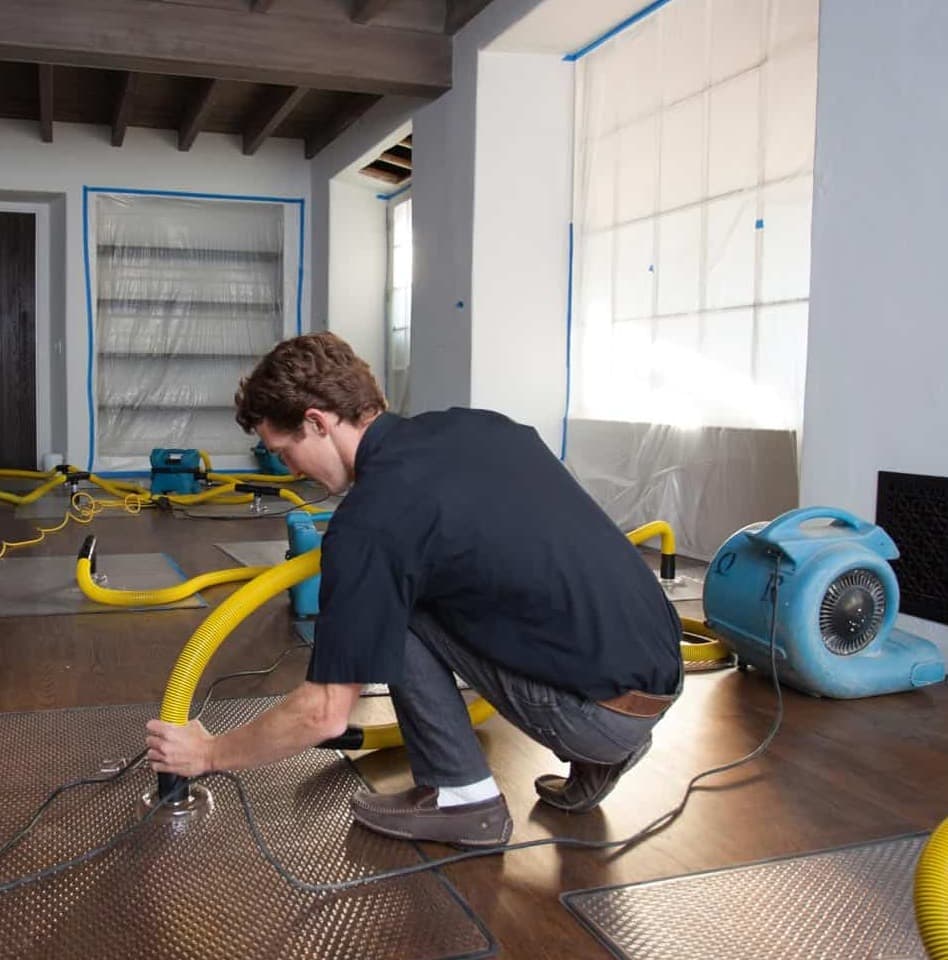
Hardwood floor drying mats
Sealed mats laid on the floor surface and connected to a vacuum system that pulls moisture up through the boards rather than waiting for it to evaporate off the top. Frequently saves original hardwood that would otherwise be pulled. Cupping is a moisture gradient rather than an automatic death sentence and boards can flatten as they equalise — but the decision has to be made in the first days, not after two weeks of a fan pointed at it.
Wall cavity injection drying
Air is directed into the wall cavity through small holes, often behind the base trim where nothing shows afterward, so the inside of the wall dries without the drywall being cut out. The alternative is a flood cut. On a wall with original plaster or milled trim, this is the difference between a drying bill and a replication bill.
Under-cabinet and toe-kick drying
The same idea applied to the void under kitchen cabinetry, which is otherwise one of the most common reasons an entire kitchen gets demolished after a modest leak. Cabinets are among the most expensive items in any scope, and the carcass is frequently fine while the void behind the toe kick stays wet.
Heat-assisted drying
Raising the temperature of the material rather than the room speeds evaporation on stubborn assemblies. Powerful and easy to misuse — too aggressive on hardwood or plaster splits and cracks the very thing you were trying to save, which is why it belongs with someone reading meters rather than watching a clock.
Containment as a drying tool
Sealing off a small affected area instead of conditioning a whole floor concentrates the equipment on the volume that is actually wet. It reaches dry standard faster with fewer machines, and it is a sign somebody calculated rather than filled the space.
When removal genuinely is the right answer
None of the above beats removal on a contaminated loss, on saturated pad and batt insulation, or on material wet long enough to have moved category. Specialty drying is for material worth saving that can still be verified dry — not for avoiding a removal that should happen.
The paperwork that matters
The daily drying log, and how to read it
This is the single document separating a measured job from an expensive guess, and you are entitled to see it every day rather than at the end. It is also what protects you, because it is the record of what was actually wet and when it stopped being wet.
A dry standard, taken from an unaffected area
The target is not a number from a manual. It is the moisture content of the same material, in the same house, somewhere the water never reached. Without that baseline every other reading on the sheet is a number with no meaning. If nobody can show you the dry standard, drying is being judged by feel.
Named measurement points, read in the same places daily
Not "the wall" — a specific labelled point, read every visit. That is what makes a downward trend real rather than an artefact of measuring somewhere slightly drier today than yesterday.
Temperature and humidity in three places
The affected area, an unaffected area, and outside. Together these show whether conditions can actually support drying. A chamber that is not dropping is usually a conditions problem, and this is where that becomes visible instead of mysterious.
The equipment count, and any change to it
How many air movers, how many dehumidifiers, and where. When a machine is added or pulled the log should say so and why. Equipment that quietly appears and stays is a line item; equipment that leaves early is a risk.
A trend, not a snapshot
Readings should fall day over day. A flat line across two consecutive days means something is wrong — a wet cavity nobody opened, a Class 4 material needing a different approach, or conditions the equipment cannot overcome. Flat readings are information and should trigger a change rather than another day of the same.
A documented endpoint
The job ends when affected materials read at the dry standard, and the log is what proves it. Equipment pulled on a date rather than on a reading is the most common origin of a mould call six weeks later — and with no log, nobody can establish afterwards which one happened.
Where jobs actually go wrong
Mitigation and reconstruction are two different jobs
Almost every bad restoration story is a story about the seam between these two rather than about either one being done badly. Knowing where the line falls, and who owns it, is most of what protects a homeowner.
Mitigation is the emergency half
Stopping the spread, extracting, removing what cannot be dried and drying what can, to a documented standard. Measured in days, driven by readings, ends on a number. Speed genuinely matters here, because category escalates with contact time.
Reconstruction is the rebuild half
Insulation, drywall, trim, flooring, paint, cabinetry — putting the room back. Measured in weeks, driven by scheduling and materials, and speed matters far less than sequencing. It is also licensed building work, which mitigation on its own is not.
The seam is where schedules die
When two companies split the job, the hand-off has no owner. The classic failure is reconstruction starting before the cavity reached dry standard, because the rebuild crew was booked and the drying crew had already left. What gets closed inside a wall does not announce itself for months.
Ask who owns the seam before you sign
A completely fair question, and the answer tells you a lot. If it is one company, ask to see the drying log before rebuild starts. If it is two, ask which one decides the readings cleared, and get that in writing rather than assuming it will be obvious later.
Why we hold both halves
Not because splitting is illegitimate — plenty of good work is done that way. It is that on this region’s older housing the rebuild frequently involves replicating plaster, milled trim and original flooring rather than buying replacements, and those decisions get made during demolition. One accountable crew means the person deciding what comes out is the person who has to put it back.
What you should hold at the hand-off
The final drying log showing readings at dry standard, photographs of what was removed and why, and a written reconstruction scope covering what goes back. With those three the seam is documented. Without them it is a verbal agreement about a wall nobody can see inside anymore.
Need Water Damage Restoration? We're Ready.
24/7 emergency response. On-site within 60 minutes. Free estimates.
What Our Water Damage Restoration Customers Say
Real reviews from Southeast Michigan homeowners
“Prime Restoration is a solid company in Michigan for basement floods and water damage. They're professional, knowledgeable and the kind of team you'd want handling a stressful situation.”
Nathan M.
Verified Google Review
Water Damage Restoration FAQ
Answers to the most common questions from Michigan homeowners
How much does water damage restoration cost in Michigan?
Water damage restoration costs in Michigan typically range from $1,500 to $7,500 depending on the extent of damage, water category (clean, gray, or black water), affected square footage, and whether structural repairs are needed. Most homeowners insurance policies cover sudden and accidental water damage. Prime Restoration produces Xactimate scope documentation compatible with major Michigan carriers and can provide a detailed estimate within hours of our initial inspection.
How quickly should water damage be addressed?
Water damage should be addressed within the first 60 minutes if possible. Mold can begin growing on wet surfaces within 24-48 hours, and structural damage worsens significantly after 72 hours. The faster water is extracted and drying begins, the lower your restoration costs and the better the outcome for your property. Prime Restoration offers a typical 60-minute emergency response 24/7.
Does homeowners insurance cover water damage restoration?
Most homeowners insurance policies cover sudden and accidental water damage, such as burst pipes, appliance malfunctions, and storm damage. Flood damage from external sources typically requires separate flood insurance. Gradual damage from neglected maintenance is usually not covered. Prime Restoration produces Xactimate scope documentation compatible with major Michigan insurance carriers so homeowners have accurate paperwork to submit with their claim.
What is the water damage restoration process?
Professional water damage restoration follows six steps: (1) Emergency response and damage assessment, (2) Water extraction using commercial-grade equipment, (3) Structural drying with industrial dehumidifiers and air movers, (4) Cleaning and antimicrobial treatment, (5) Content restoration and inventory, (6) Structural repairs and reconstruction. The entire process typically takes 3-7 days for drying, plus additional time for repairs.
Can water-damaged drywall be saved?
Minor water exposure to drywall can sometimes be dried and saved if addressed within the first 24-48 hours. However, drywall that has been saturated, shows signs of swelling, crumbling, or has been wet for more than 48 hours typically needs to be cut out and replaced. Our technicians use moisture meters to determine which sections can be saved and which need replacement.
How long does water damage restoration take?
The water damage restoration timeline depends on the severity: Water extraction takes 1-2 days. Structural drying takes 3-5 days on average (monitored daily with moisture readings). Cleaning and sanitizing takes 1-2 days. Repairs and reconstruction can take 1-4 weeks depending on scope. Prime Restoration keeps you informed with daily progress updates throughout the process.
What are the signs of hidden water damage?
Signs of hidden water damage include: unexplained increases in your water bill, musty or moldy odors, discoloration or staining on walls and ceilings, peeling or bubbling paint, warped or buckling floors, damp or wet spots on walls, condensation on windows, and visible mold growth. If you notice any of these signs, call for a professional inspection immediately.
Do I need to leave my home during water damage restoration?
In most cases, you can remain in your home during water damage restoration, as long as the affected area can be safely contained. However, if sewage (Category 3 water) is involved, if mold is widespread, or if the damage affects your home electrical systems or structural integrity, temporary relocation may be recommended for safety. Prime Restoration will advise you based on your specific situation.
How do you prevent mold after water damage?
Preventing mold after water damage requires rapid water extraction (within the first 24 hours), thorough structural drying using commercial dehumidifiers and air movers, application of professional-grade antimicrobial treatments, proper disposal of unsalvageable materials, and continuous moisture monitoring until dry standard is reached. Professional restoration is the most reliable way to prevent mold growth after water damage.
What is the difference between water mitigation and water restoration?
Water mitigation refers to the immediate emergency steps taken to prevent further damage — water extraction, drying, and antimicrobial treatment. Water restoration is the complete process of returning your property to its pre-loss condition, including repairs, reconstruction, and finishing work. Prime Restoration handles both mitigation and full restoration as one seamless process.
What is a water damage "Class", and why has nobody mentioned it to me?
Category is how dirty the water is. Class is how much the materials absorbed and how hard it will be to get back out — and it is the half of the assessment that actually decides how much equipment lands in your house and for how long. Class 1 is the least absorption, where a small portion of a room took water into low-porosity material. Class 2 is a whole room into carpet, pad and the lower walls, which is the most common finished-basement loss. Class 3 is water that came from overhead and soaked everything on the way down, including the ceiling, which makes it the largest equipment load of the common classes. Class 4 is water bound inside materials that will not release it on a normal curve — hardwood, plaster, stone, concrete, block cores — which is extremely common in this region's pre-war housing and is where a job that looks dry on day three genuinely is not. Two Category 1 losses of identical size can be a Class 1 and a Class 4 and are not the same job at all. It is fair to ask a contractor to state the Class and justify it before equipment goes in.
How do I know the right amount of equipment is in my house?
The quantity is calculated from the affected area, the Class and the conditions in the room — it is not a judgement call, and more machines is not automatically better. What you want to see is a plan: air movers angled to sheet air across wet surfaces in a loop around the room rather than scattered, and enough dehumidification to actually remove what all that air movement is putting into the air. Air movers add moisture to the room air and remove none from the building; the dehumidifier is the machine that takes water out of the house. A room full of fans with one small dehumidifier is a room reaching equilibrium at high humidity and then stopping. The counter-check is the daily log: if readings are falling day over day the setup is working, and if they are flat for two consecutive days something needs to change rather than continue.
Can my hardwood floor be saved, or does it have to come out?
Often it can, and the decision has to be made in the first days rather than after two weeks of a fan pointed at it. Specialty floor drying uses sealed mats laid on the surface and connected to a vacuum system that pulls moisture up through the boards instead of waiting for it to evaporate off the top. Cupping is a moisture gradient rather than an automatic death sentence — boards can flatten as they equalise. The same principle applies elsewhere: wall cavity injection dries the inside of a wall through small holes hidden behind base trim so the drywall never gets cut out, which on a wall with original plaster or milled trim is the difference between a drying bill and a replication bill; and under-cabinet drying addresses the void behind a toe kick, which is otherwise one of the most common reasons a whole kitchen gets demolished after a modest leak. Ask for these by name. What none of them beats is removal on a contaminated loss, on saturated pad and batt insulation, or on material wet long enough to have moved category.
What should be in the daily drying log, and can I see it?
You should see it every day rather than at the end, and it should contain six things. A dry standard taken from the same material in an unaffected part of your house — without that baseline every other number is meaningless. Named measurement points read in the same places each visit, not "the wall." Temperature and relative humidity in three places: the affected area, an unaffected area and outdoors, which together tell you whether conditions can even support drying. The equipment count and any change to it, with a reason. A downward trend rather than a snapshot. And a documented endpoint, because the job ends when materials read at the dry standard, not on a date. Equipment pulled on a schedule instead of on a reading is the most common origin of a mould call six weeks later, and without a log nobody can establish afterwards which one happened.
Is a thermal camera actually finding the water?
It is finding where to point a meter, which is a genuinely useful thing and not the same thing. Thermal imaging reads surface temperature rather than moisture. Evaporating water cools a surface, so wet areas usually show as a cool pattern — but so do plenty of other things, including a draught, a cold water line and a missing patch of insulation. That makes thermal excellent for scanning a large area fast and useless as proof on its own. The measurement comes from meters: a non-penetrating meter reads a shallow depth without marking the surface and is good for scanning, while a penetrating meter uses pins driven into the material and is the one that tells the truth about depth — into a bottom plate, into a joist, past a floor covering. A job read only with the non-penetrating meter is a job read optimistically. If someone shows you a thermal image as evidence the wall is dry, ask for the pin reading.
Should one company do both the drying and the rebuild?
Splitting them is legitimate and plenty of good work is done that way — but the seam between them is where almost every bad restoration story actually happens, so it needs an owner. Mitigation is the emergency half: extract, remove what cannot be dried, dry what can to a documented standard. It runs in days and ends on a number. Reconstruction is the rebuild half: insulation, drywall, trim, flooring, cabinetry. It runs in weeks and is licensed building work, which mitigation alone is not. The classic failure is reconstruction starting before the cavity reached dry standard, because the rebuild crew was booked and the drying crew had already left — and what gets closed inside a wall does not announce itself for months. So ask who decides the readings cleared and get it in writing. Whichever way you go, you should hold three things at the hand-off: the final drying log showing dry standard, photographs of what was removed and why, and a written reconstruction scope.
Water Damage Restoration Service Areas
Serving all of Macomb County and Oakland County, Michigan
Macomb County
Prime Restoration is a Michigan restoration contractor headquartered at 13854 Lakeside Circle, Suite 558, Sterling Heights, MI 48313, with a Rochester office serving Oakland County. Our trained restoration team provides water damage restoration across Macomb County and Oakland County, with 60-minute emergency response and direct billing to State Farm, AAA, Auto-Owners, Citizens, Allstate, Farmers, USAA, Progressive, and Meemic.
Ready to Get Started?
Call now for 24/7 emergency water damage restoration service in Southeast Michigan.