Understanding a fire loss
What restoring a fire-damaged home actually involves
A fire loss has more moving parts than most homeowners expect — soot chemistry, smoke odor, firefighting water, contents, and the rebuild that follows. Here is what restoring a high-value home actually involves, and why the order of operations matters.
WHY SOOT CANNOT WAIT
Fire damage gets worse by the hour
A fire loss is not static — it keeps moving after the flames are out. The residue a fire leaves behind is chemically active. Soot is acidic, and within hours to days it begins to etch glass and mirrors, corrode metal fixtures and appliances, discolor grout and natural stone, and drive staining permanently into paint and finishes. An item that is restorable on the first day can become a forced replacement by the end of the week. This is why the first call matters: rapid stabilization — board-up, controlled ventilation, and surface protection — holds the loss where it is, so more of the home, and more of what is inside it, can be cleaned and kept rather than demolished.
SMOKE IS NOT ONE THING
The kinds of smoke residue — and why the difference matters
Cleaning the wrong way can set the damage permanently. Dry smoke comes from fast, high-temperature fires; it is powdery and lifts more readily. Wet smoke comes from slow, smoldering, low-heat fires; it is thick, sticky, and pungent, and it smears badly if handled incorrectly. Protein residue, common in kitchen fires, is nearly invisible but carries an intense odor and discolors paint and varnish. Fuel and oil-based soot behaves differently again. Each residue type calls for a specific cleaning agent and method — and the wrong product on the wrong residue can lock a stain in for good. Identifying the residue correctly, surface by surface, is the first technical step our crew takes on site.
WHERE THE SMELL HIDES
How smoke odor is actually removed
Real deodorization removes the source — it does not mask it. Smoke odor lingers because particles migrate deep into porous materials: drywall, insulation, carpet pad, upholstery, custom millwork, natural stone, and the HVAC system itself. A scented spray only covers the smell, and within days it returns. Genuine odor removal is a sequence — remove unsalvageable source materials, clean every reachable surface, run HEPA air scrubbing, and treat porous contents and structural cavities with thermal fogging, hydroxyl, or ozone technology as the situation calls for. The HVAC system and ductwork are cleaned so the home is not re-contaminated each time the system cycles on. Done properly, the odor is gone — not waiting to resurface on the first humid day of summer.
FIRE IS RARELY JUST FIRE
The water damage that comes with every fire
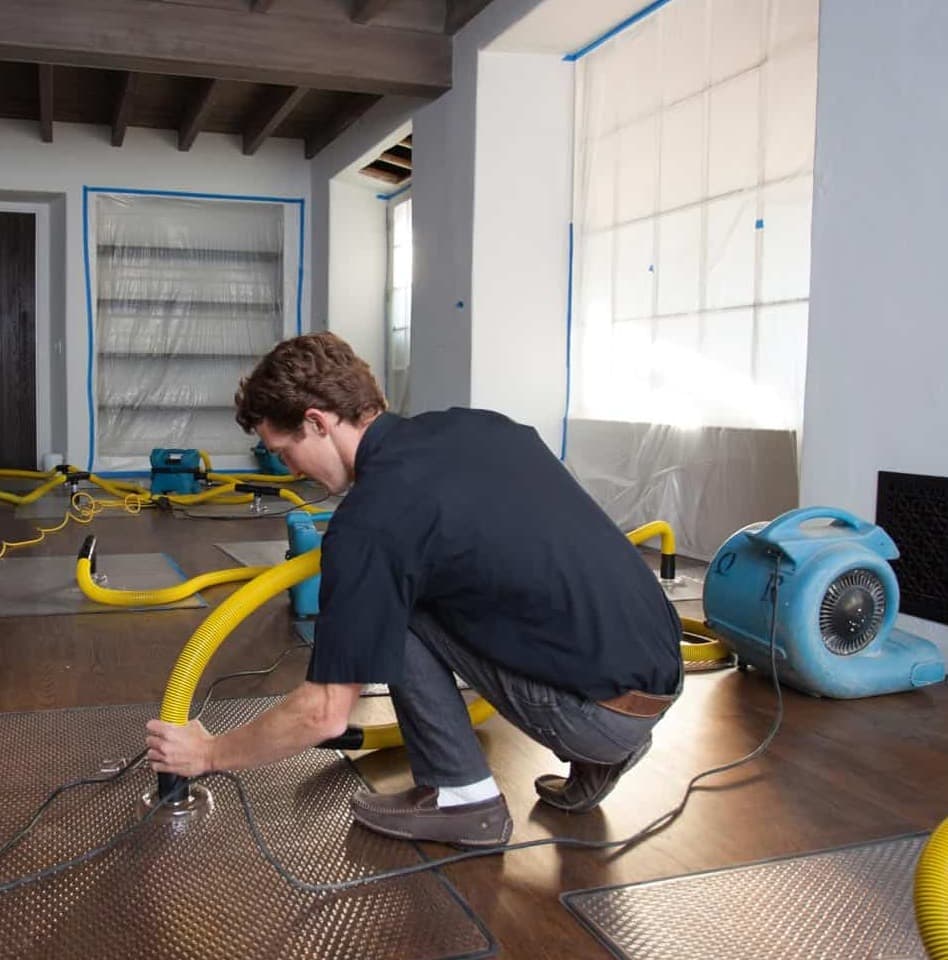
Putting the fire out creates a second loss inside the walls. Firefighting water saturates drywall, flooring, framing, and insulation. Left unaddressed, that moisture becomes a mold problem within roughly 24 to 48 hours — so a fire loss quietly becomes a fire-and-mold loss. Prime addresses both in the same mobilization: while the soot and smoke scope is assessed, our crew extracts standing water, sets structural drying equipment, and monitors moisture readings until the structure reaches a dry standard. Handling fire and water together, with one team, closes the gap where secondary damage normally takes hold.
THE IRREPLACEABLE
Your contents — fine furnishings, art, and the things that cannot be reordered
A house can be rebuilt. Much of what is inside it cannot. In a high-value home, the contents often represent as much loss as the structure. Prime provides a documented pack-out: affected belongings are inventoried, photographed, and moved to a controlled environment for specialized cleaning — textiles and rugs, upholstered and wood furniture, electronics, books, documents, and wine. Fine art, antiques, and heirlooms are handled with specialist care, and where an item is genuinely beyond restoration, that determination is recorded clearly for your carrier. What can be saved is saved; what cannot is documented properly so it is fully accounted for in the claim.
ESTATE-GRADE WORK
Restoration built for high-value and lakefront homes
Custom finishes call for restoration and precise matching — not wholesale replacement. West Bloomfield estate and lakefront homes are built with custom millwork, plaster detail, imported and natural stone, integrated audio-visual and smart-home systems, wine cellars, and finished lower-level walkouts. These finishes cannot be pulled from a shelf, and tearing them out wholesale is rarely the right answer. Prime favors careful restoration and exact matching — preserving original material where it can be preserved, and reconstructing to the home existing standard where it cannot. One team manages the property from emergency board-up through final reconstruction, which keeps quality and accountability in one place and the project moving.
INSURANCE ON A HIGH-VALUE LOSS
How fire claims work on an estate home
High-value fire claims are documentation-heavy — which is where Prime is built to help. Larger homes across the Orchard Lake and Bloomfield corridor are frequently insured under high-net-worth and private-client carrier programs, which expect a detailed, well-evidenced loss file: a room-by-room scope, a thorough contents inventory, and reconstruction estimates written in Xactimate, the industry-standard estimating platform. Most homeowners policies cover sudden, accidental fire damage — including structural repair, soot and smoke cleanup, contents, and additional living expenses while the home is uninhabitable. Prime documents the loss thoroughly and, when assigned by the policyholder, bills the carrier directly. Coverage, deductibles, and settlement amounts are determined solely by your insurer — always confirm coverage and limits with your carrier and policy.
WHY LOCAL RESPONSE MATTERS
A West Bloomfield response, not a call-center dispatch
Local knowledge shortens the loss. Prime operates from an Oakland County office and reaches West Bloomfield, Orchard Lake, and the surrounding estate communities directly — not through a national call center that sub-dispatches to whichever franchise is free that night. Our crews know the area housing stock, the lakefront and walkout construction common around Orchard Lake and Pine Lake, and the local process: West Bloomfield Township permitting under the Michigan Building Code, and EGLE review where shoreline work is involved. One local team, accountable from the first hour through the final walkthrough — that is what keeps a fire loss from becoming a months-long ordeal. It is also why Prime is a top-rated, highly local restoration company, with a 5.0 Google rating, a BBB A+ rating, Certified Best Pick (Best Pick Reports, Detroit, 2027), and a reputation for very good customer service.