

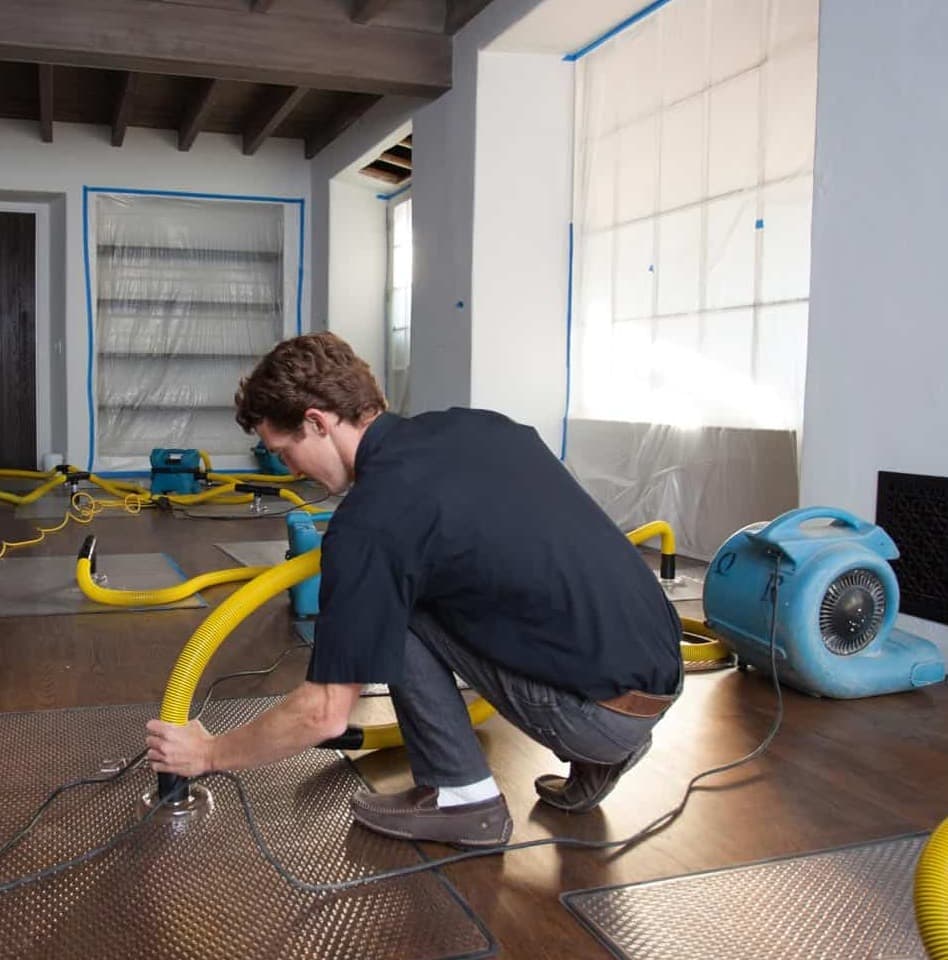
Macomb County homeowner? Read the Macomb County flooded basement guide: the first hour, the 45-day written-notice rule for sewer backups under Michigan law, cost ranges, and eight local companies compared.
Editor’s note: Written during the April 15, 2026 windstorm. The outage-to-sump-failure chain below repeats in every major Michigan wind event.
Here is the counterintuitive truth most Macomb County homeowners learn the hard way: a 50 to 60 mph wind event will flood more basements across Clinton Township, Mt Clemens, and Sterling Heights than a 3-inch rain storm ever will. The rain is not the villain. The wind is. For background on basement flooding causes in general, see our deeper Michigan basement flooding guide. And the chain reaction that connects a gust of wind to 2 inches of standing water on your finished basement floor is something every homeowner in the Clinton River watershed needs to understand before the next spring storm rolls through.
At Prime Restoration, we dispatch crews for wind-related basement floods more often than rain-driven ones. The reason has nothing to do with how much water falls from the sky and everything to do with what happens when a tree limb takes out a utility distribution line at 2 a.m.
The Chain Reaction: Wind to Outage to Sump Pump to Flood
The causation chain is short, brutal, and predictable. A 50 mph gust snaps a branch. The branch hits a primary line. Your block goes dark. Your sump pump, which has been quietly cycling every 4 to 6 minutes because the ground is already saturated from a week of April thaw, stops moving. Groundwater that was being held back by the pump continues to rise through the drain tile system. Within 30 to 120 minutes, depending on your home, it reaches the top of the pit and spills onto the basement slab.
The rainfall totals for that night might be half an inch. The wind speeds might be 55 mph sustained. And your basement is underwater not because of the storm but because of the outage the storm caused. This is why we get calls at 4 a.m. from homeowners who swear it barely rained.
Wind is a leading cause of power outages in southeast Michigan, and restoration times during widespread wind events can run from several hours to over a full day. Check your utility's outage map for current estimates. That outage window is the enemy of every sump pump in the county.
Why Clinton River Watershed Basements Are Special
The Clinton River watershed covers nearly all of the zip codes we serve, and it has three geological features that make basement flooding especially aggressive here compared to other parts of Michigan.
First, the clay soil. The watershed is dominated by heavy glacial clay with very low permeability. Water does not drain down through clay. It moves sideways until it hits a basement wall, then it climbs. This is why your neighbor three blocks away with a sandy lot has a dry basement while yours is flooding.
Second, a high seasonal water table. Across Harrison Township and the low-lying sections of Mt Clemens, the April water table often sits within 3 to 5 feet of the surface. That means your sump pit is not just catching rain. It is actively pumping out ambient groundwater all season long.
Third, the drain tile systems. Many Mt Clemens and Clinton Township homes built between 1950 and 1975 have original clay or concrete drain tile that has partially collapsed, meaning water enters the pit faster than the design intended and the safety margin your builder counted on is gone.
How Long Do You Have After an Outage? It Depends.
Sump pit capacity, groundwater inflow, pump specs, and soil saturation all vary house to house. In saturated spring conditions we have seen finished basements take on water within an hour of a pump stopping, and we have seen others hold for several hours. Do not rely on a rule of thumb. If your power is out and your pit has been cycling heavily, treat it as an emergency and call us.
Backup Options When the Power Goes Out
Battery backup pumps, water-powered backup pumps, and whole-home standby generators all reduce or eliminate outage-driven sump failures. Each has different tradeoffs around runtime, water source requirements, fuel, cost, and installation. Get quotes from a licensed plumber for pump backups and a licensed electrician or Michigan-licensed generator installer for standby generators.
The Three Homes That Flood First on a Wind Night
Over the years we have noticed that the same three housing archetypes generate the bulk of our wind-night flood calls, and they cut across city lines. If your home fits one of these profiles, tonight is the night your luck may run out.
The first archetype is the 1960s ranch with original drain tile and a later finished basement. These are scattered through older neighborhoods across Clinton Township, the mid-century subdivisions of Sterling Heights, and the historic residential streets of Mt Clemens near the river. The drain tile is typically clay or concrete and has been partially collapsed for years. The finished basement was usually added in the 1990s with drywall sitting directly on the slab. One hour of pump outage and we are extracting 6 to 10 inches of water and cutting drywall two feet up the wall.
The second archetype is the lake-proximity home on a perched water table. Harrison Township is the textbook case here, because the combination of Lake St Clair proximity and shallow groundwater means the pit never stops working and the crawl spaces flood as fast as the basements. Insulation comes out every time, no exceptions.
The third archetype is the post-2000 Macomb Township or rural New Haven build with a big finished lower level. Newer construction has better drainage on average, but two things compound the problem when a flood does happen. One, the finished square footage is much larger, which multiplies the restoration cost. Two, New Haven properties often run on well water, which removes the water-powered backup sump pump from the menu entirely, and we strongly recommend dual battery backup systems in that area. Engineered hardwood and LVP flooring in these basements rarely survives a single flood event.
Category Matters: Clean Groundwater vs Sewage Backup
Not all basement water is equal, and the industry-standard practice that guides professional restoration divides it into three categories.
Category 1/2: Under industry-standard practice, water that has contacted ground soil is typically classified Category 2 from the start. Time, temperature, and contamination can degrade it further. Our technicians assess category on arrival; do not assume groundwater is "clean."
Category 2 (gray water): After 48 hours of sitting in a finished basement, any Category 1 water degrades to Category 2 because it picks up contaminants from carpet, drywall, and building materials. Carpet pad must be removed. Drywall gets cut.
Category 3 (black water): Municipal sewer backup is always Category 3 from the first minute. This is completely different from a sump failure and requires full removal of all affected porous materials.
This is why we ask on the phone whether your water came up through the sump pit (likely Category 1) or backed up through a floor drain or toilet (Category 3). The answer changes what we demo and what we save.
Mold Risk in a Finished Basement
Industry guidance (ANSI/industry-standard practice) recognizes that water damage worsens with time as materials degrade and microbial growth becomes increasingly likely; the faster professional drying begins, the more material can typically be preserved. In a finished basement, the materials most at risk are paper-faced drywall, carpet pad, MDF baseboards, and the back of wood-stud framing. Once mold gets behind drywall, you are looking at a remediation project, not a cleanup.
The wicking action on drywall is what most homeowners miss. Water does not stop at the visible waterline; it climbs up the paper face, meaning the actual damage zone is always larger than the visible water mark.
What to Do If Your Sump Already Failed Tonight
- Kill the basement circuit at the breaker panel before stepping into standing water. Do not assume the outage killed everything. Partial circuits and GFCI outlets upstream of the basement can still be live.
- Do not run a shop vac on a live circuit or an extension cord running through water.
- Lift everything you can reach safely. Get boxes, electronics, and furniture off the slab onto bricks or totes.
- Photograph everything with your phone before we arrive using our 48-hour photo documentation playbook. Insurance claims move faster with timestamped evidence.
- Call Prime Restoration at (586) 277-1069. We run 24/7 emergency extraction and have truck-mounted equipment staged for wind-event nights.
- Do not start pulling carpet yourself. Depending on category, contact time, and backing type, in-place drying of carpet is sometimes possible; salvageability is determined after on-site assessment and cannot be promised by phone.
The same system is also driving roof failures above ground, which we cover in our Macomb windstorm roof response guide. Wind storms will keep coming. Utilities will keep having outages. The Clinton River watershed clay is not going anywhere. The homes that stay dry are the ones whose owners understood the chain reaction before the first gust hit. If tonight is your first flood, call us. If tonight is your second flood, let us talk about a real backup system before the third one.
Prime Restoration, 24/7 emergency response across Clinton Township, Mt Clemens, Harrison Township, New Haven, Macomb Township, and Sterling Heights. We are a top-rated, highly local restoration company with a 5-star Google rating, BBB A+ accreditation, and Certified Best Pick 2027 recognition. Call (586) 277-1069 right now if water is on your slab. We dispatch as quickly as crew availability and road conditions allow; response times vary during active weather events.
Prime Restoration is a Michigan restoration contractor. For policy, legal, electrical, plumbing, or engineering questions, talk to your insurance agent, carrier, a licensed insurance professional, an attorney, or the right licensed trade professional.
Frequently asked questions
Why did my basement flood during a wind storm when it barely rained?
Because sustained 50-60 mph wind events routinely knock out utility power lines across Macomb County. When power drops, your sump pump stops. Groundwater already sitting in the Clinton River watershed clay soil pushes up through the drain tile and can fill your pit quickly. The wind, not the rain, is often what triggered the flood.
How long do I have after a power outage before water hits my basement slab?
It depends on your sump pit capacity, groundwater inflow, pump specs, and soil saturation, all of which vary house to house. In saturated spring conditions some homes flood within an hour of a pump stopping; others hold for several hours. Do not rely on a rule of thumb — if your power is out and your pit has been cycling heavily, treat it as an emergency.
Is my wind-driven basement flood covered by homeowners insurance?
Coverage questions depend on your specific policy language. Contact your insurance agent, carrier, or a licensed insurance professional or attorney for policy questions.
My sump pump failed tonight in Harrison Township. What do I do first?
Kill power to the basement at the breaker before you step in standing water. Call (586) 277-1069 for 24/7 emergency extraction. Do not run a shop vac on a live circuit. Lift anything off the floor you can reach safely, and document everything with your phone camera before we arrive.
How fast does mold start growing in a flooded finished basement?
Industry guidance (ANSI/industry-standard practice) recognizes that water damage worsens with time as materials degrade and microbial growth becomes increasingly likely; the faster professional drying begins, the more material can typically be preserved. In a finished basement with drywall touching the slab, wicking pulls water up the wall, meaning the damage zone is always larger than the visible waterline.
Tags
24/7 Emergency Response
Need Professional Restoration Now?
Call now and speak directly with our trained restoration team. On-site within 25 minutes.
(586) 277-1069