
When a storm puts a tree through a Rochester roof, choosing a restoration company is not a leisurely process. The clock starts the moment the breach happens, and the homeowners who come out of these losses cleanly are almost always the ones who made parallel calls — restoration and arborist — within the first hour. The wrong sequence can add days of additional water damage to a claim that started as a contained roof issue.
The best storm damage restoration company in Rochester is not the one with the biggest yard sign. It is the company that arrives quickly with self-adhered membrane tarping, knows how to coordinate with arborists on tree removal, performs structural assessment after the tree is off, and runs interior water mitigation in parallel before secondary mold takes hold.
What Rochester Homeowners Look For
Across Rochester and Rochester Hills, homeowners weigh a short list of criteria when a storm event causes structural damage:
- Fast emergency tarping. Real self-adhered membrane mechanically fastened to sound decking, not a blue plastic sheet. Within 4 to 8 hours of the call.
- Arborist coordination. Tree removal is its own trade. The right restoration company has trusted arborists and sequences the work so the breach is tarped before the roof sits open overnight.
- Structural assessment. Lateral framing displacement, foundation impact, and plumbing or HVAC vibration damage are routinely missed in initial scopes. The right company looks for them.
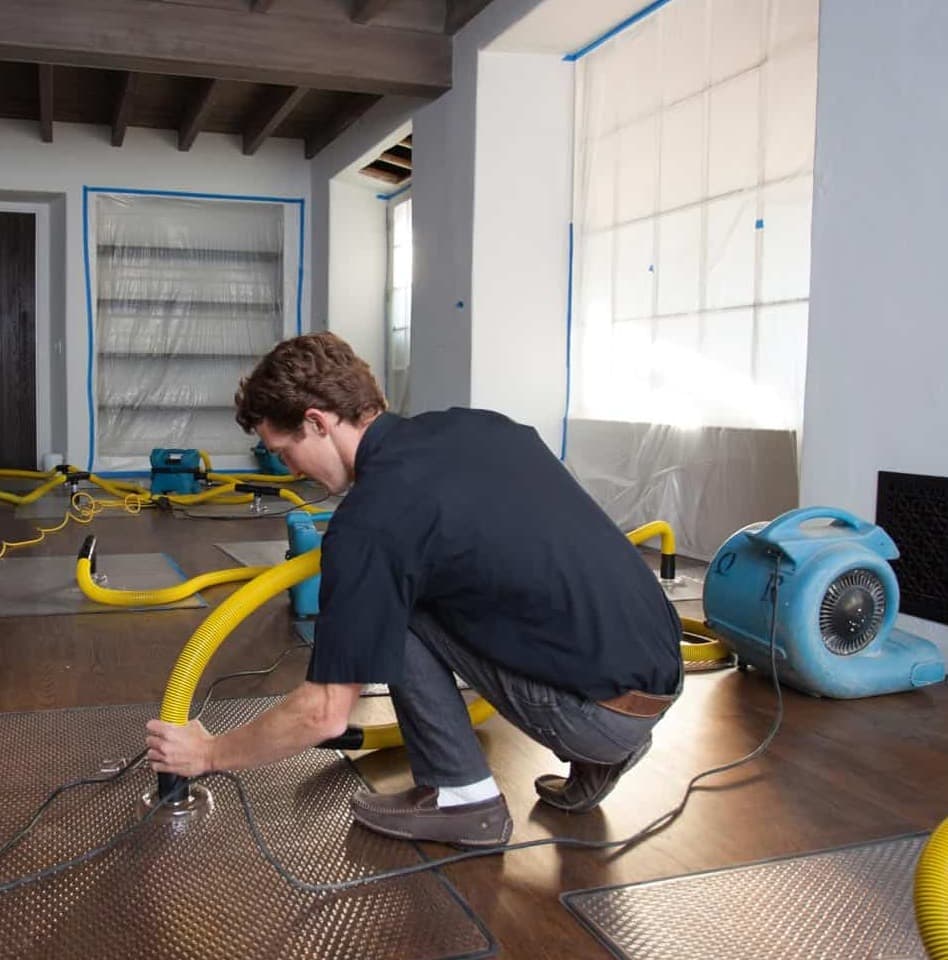
- Interior water mitigation in parallel. If the breach was open during rain, drying equipment goes in within 24 to 48 hours per industry-standard mitigation to prevent secondary mold.
- Carrier-direct billing on covered claims. Tree-damage claims involve multiple sub-limits (dwelling, other structures, debris removal). The right company knows how to scope each.
Below is a deeper look at why fallen-tree damage is the dominant storm claim in tree-canopied Rochester, who pays for what under a standard HO-3, and the right sequencing for emergency work — so homeowners can evaluate restoration companies with a sharper sense of what specifically matters in this area.
Why Tree Damage Is the Dominant Storm Claim Here
The city of Rochester has held Tree City USA recognition from the Arbor Day Foundation for multiple decades, reflecting an active municipal forestry program. Rochester Hills similarly maintains an extensive tree inventory along arterial corridors and in subdivision common areas. The practical effect for homeowners is dense, mature canopy on residential streets, with a meaningful percentage of trees now in the 50- to 80-year age range.
Several factors drive the claim frequency:
- Mature silver maples, ash (where surviving Emerald Ash Borer), and white pine commonly reach 60 to 90 feet at maturity, putting structures within strike distance.
- The Emerald Ash Borer infestation, which arrived in southeast Michigan in the early 2000s, left a residue of standing dead and weakened ash trees in older subdivisions. Those trees are still failing.
- Heavy wet-snow events in late autumn and early spring add load to canopies that haven't fully dropped leaves.
- Saturated soils after multi-day rain events reduce root anchorage. A tree that stood through 60 mph wind in dry conditions can fail at 35 mph in saturated ground.
- Straight-line winds and severe-thunderstorm gust fronts moving through the I-75 corridor reach the area regularly during the April-through-August storm season.
The National Weather Service Threshold
The National Weather Service White Lake office, which covers Oakland County, classifies wind damage at and above 58 mph as a severe-thunderstorm threshold. Tree failure begins materially earlier than that — typically in the 40 to 50 mph range for already-weakened trees. Most fallen-tree claims in Rochester are not from named storms; they are from routine summer thunderstorms with gust fronts in the 45 to 60 mph range.
Who Pays: Your Tree, Their Tree, City Tree
The single most common homeowner question after a tree-strike is "whose insurance pays?" The answer is consistent across nearly every claim scenario in Michigan, and it surprises people:
- Your tree falls on your house — your homeowners policy.
- Your neighbor's tree falls on your house — your homeowners policy.
- City street tree falls on your house — your homeowners policy.
- Your tree falls on your neighbor's house — their homeowners policy.
The principle is that property-damage coverage follows the property, not the tree. The exception is negligence: if the tree was visibly dead, diseased, or had been the subject of a documented complaint and the owner did nothing about it, your insurer can pursue subrogation against the tree owner's liability coverage. In practice, this is a small fraction of claims because proving prior knowledge is difficult.
The Documentation That Matters in a Negligence Case
If you believe your neighbor knew the tree was a hazard, the documentation that supports a successful subrogation includes:
- Photographs of the tree pre-failure showing visible decay, dead crown, hollow trunk, or fungal conching.
- Written communication (text, email, letter) where the hazard was raised with the tree owner.
- Arborist reports if any prior assessment was performed.
- Municipal complaint records if a formal report was filed with the city.
Without that paper trail, "the tree was obviously rotten" is rarely enough to shift the loss.
What Your Policy Actually Covers (and Doesn't)
The Michigan-standard HO-3 homeowners policy covers tree damage under several distinct provisions, and understanding them matters because adjusters apply each cap separately:
- Coverage A (Dwelling). Pays for damage to the house structure itself — roof, walls, framing, attached garage. Subject to your wind-and-hail deductible, which is often 1% to 2% of the dwelling limit.
- Coverage B (Other Structures). Pays for damage to detached structures — sheds, detached garages, fences. Typically limited to 10% of Coverage A.
- Coverage C (Personal Property). Pays for contents damaged by the tree strike or by subsequent water intrusion through the breach.
- Coverage D (Loss of Use). Pays for additional living expenses if the home is uninhabitable during repairs.
- Tree Debris Removal. A specific sub-limit, typically $500 to $1,000 per tree with a $1,500 to $2,000 aggregate per loss, applies only when the fallen tree damages a covered structure.
Trees that fall in your yard without striking a covered structure are almost universally not covered for removal. That cost — typically $800 to $3,500 for a large tree depending on access, hazard level, and disposal — falls to the homeowner.
The Right Sequence After a Tree Strike
Sequencing is where homeowners most often lose money. Done correctly, the steps overlap intentionally and minimize secondary damage. Done incorrectly, you can spend more on emergency tarping than you ever recover from the insurance scope.
- Safety first. If the tree took down a power line, do not approach. Call DTE Energy and the utility will dispatch before any tree work starts. Live lines on a downed tree are the leading cause of post-storm fatalities.
- Document immediately. Photographs from multiple angles, ideally before anything is moved. Wide shots showing the full scene, mid-range shots showing the structural breach, close-ups of damaged materials.
- Notify your insurer. Most carriers have 24/7 claim lines; call within the first few hours rather than waiting until morning. The claim number anchors all subsequent work.
- Emergency tarping. Before tree removal. The tarp goes over the breach to prevent additional water intrusion if more weather arrives. A licensed restoration contractor can typically tarp within 4 to 8 hours of a call.
- Tree removal by a qualified arborist. Once the structure is weatherized, the tree comes off. This is its own contractor in most cases — restoration companies typically subcontract or coordinate with arborists rather than performing removal in-house.
- Structural assessment. After the tree is off, the actual damage is visible. A qualified contractor or structural engineer evaluates rafters, sheathing, ceiling joists, and any wall framing that was hit.
- Interior water mitigation if applicable. If the breach was open during rain, drying equipment goes in promptly to prevent secondary mold growth. Under industry-standard practice, the typical target is to begin drying within 24 to 48 hours of the loss.
- Full restoration scope. Roofing, framing, drywall, paint, and any flooring or contents work proceed once the structure is dry and the scope is agreed.
The Tarping Mistake That Costs Real Money
The most common sequencing error is allowing the tree-removal crew to leave a roof open overnight before tarping. This happens often when the tree-removal call goes in first (because the homeowner can see the tree) and the restoration call is treated as a "next-day" item. If even modest rain arrives in the gap, you can add several thousand dollars of interior damage to a claim that started as a contained roof issue.
The right approach is parallel calls: tree-removal contractor and restoration contractor dispatched simultaneously, with the restoration crew arriving first to tarp the breach if the tree's position allows safe access, or immediately after the tree is moved if it does not.
Hidden Damage You Should Look For
Tree-strike claims are notorious for under-scoping because adjusters and contractors focus on the obvious breach. The damage that often gets missed:
- Lateral framing displacement. The impact transfers force horizontally through the structure. Walls 20 feet from the strike point can show cracked drywall seams or door-frame racking.
- Foundation impact. Heavy trees that hit corners or partially uproot can transfer stress to foundation walls. Hairline cracks or shifted basement framing should be photographed.
- Plumbing and HVAC breaks. Vibration from a tree strike commonly cracks copper sweat joints, dislodges drain stacks, or shifts furnace flue sections.
- Electrical service damage. If a service drop was pulled or the meter base shifted, even slightly, it requires DTE inspection before re-energization.
- Compromised attic insulation. Wet insulation loses R-value permanently. Replacement is typically covered but routinely missed in initial scopes.
- Soffit and fascia damage at the strike-side eave. Often visible only after the tree is removed.
Pre-Loss Steps That Help You
- Photograph the exterior of your home from all four sides every spring. This baseline saves disputes about pre-existing condition.
- Have an arborist inspect any large tree showing crown dieback, large cavities, fungal growth, or visible lean. The cost is modest compared to a removal.
- Confirm your dwelling-coverage limit reflects actual rebuild cost in current Oakland County labor and materials, which has moved significantly over the past five years. Underinsurance is more common than homeowners realize.
- Check whether your wind-and-hail deductible is a flat dollar amount or a percentage. Percentage deductibles on dwelling values above $500,000 can be a meaningful exposure.
- Save your insurer's 24/7 claim number in your phone now, not at midnight after the strike.
The Bottom Line for Tree-Canopied Rochester Homes
Mature canopy is a feature of life in Rochester and Rochester Hills, and it is also the reason fallen-tree claims dominate the storm-damage category in this corner of Oakland County. The good news is that the claim path is well-established: your own policy almost always pays, structure removal is covered when a structure is hit, and the work sequences in a predictable order if you make parallel calls early. The places homeowners lose money are sequencing errors, missed secondary damage, and under-stated dwelling limits.
Prime Restoration handles tree-strike emergency tarping and full restoration across Rochester and Rochester Hills, and coordinates directly with arborists and adjusters on multi-trade scopes. If a tree is on your roof tonight, the call to make first is the one that gets a tarp on the breach before the next storm arrives.
Frequently asked questions
My neighbor's tree fell on my house. Whose insurance pays?
In nearly every case, your own homeowners policy pays for damage to your property regardless of which yard the tree grew in. The legal standard in Michigan is negligence — your neighbor is generally only liable if you can prove they knew or should have known the tree was diseased, dead, or hazardous before it fell. A healthy tree felled by wind is treated as an act of nature, and your insurer pursues subrogation only in negligence cases.
Does my homeowners policy cover the cost of removing the fallen tree?
Most standard Michigan homeowners policies (HO-3 form) cover tree removal when the fallen tree damages a covered structure (the dwelling, an attached garage, a detached garage, or a fence), typically capped at $500 to $1,000 per tree with a $1,500 to $2,000 aggregate per loss. Trees that fall in your yard without hitting a structure are usually not covered for removal — that cost falls to the homeowner.
In what order should fallen-tree damage be addressed?
The correct sequence is: (1) safety assessment and any utility shutoffs, (2) tarping and emergency weather protection, (3) tree removal by a qualified arborist, (4) structural assessment of roof, walls, and any compromised framing, (5) interior water-damage mitigation if the structure was breached, (6) full restoration scope. Doing tree removal before tarping is a common mistake that leads to days of additional water intrusion if a follow-up storm arrives.
Tags
24/7 Emergency Response
Need Professional Restoration Now?
Call now and speak directly with our trained restoration team. On-site within 60 minutes.
(586) 277-1069